
Every page of every packet, read.
The intelligence layer on top of the agenda system your city already has. We don't replace it — we read what it publishes and turn it into answers your council can act on.
For city councils, clerks, and staff
Your council reads a 1,400-page packet on a weekend.
The packet drops Thursday night. The meeting is Tuesday. Council members are part-time, largely unpaid, and hold day jobs — and the only tools most of them have are Ctrl+F and coffee. Nobody reads all of it. Everybody votes on all of it.
| No. | Property | Value | Remark |
|---|---|---|---|
| 01 | Pages in the packet | 0 | One real published packet |
| 02 | The single PDF | 0 MB | Scanned exhibits included |
| 03 | Publication to vote | 0 days | Thursday night to Tuesday |
| 04 | Council pay | Part-time | Largely unpaid, with day jobs |
Values measured from a real published North Texas council packet.
What nobody reads gets approved anyway.
Contradictory numbers slip through
$1,000 on page 45, $1,200 on page 212 — approved in one motion, discovered in an audit.
Recurring items lose their history
The same rezoning returns for the fourth time and every new council starts over.
Questions surface at the dais
Asked in front of the public and the applicant, instead of a week earlier in an email.
Reads what your city publishes. Returns answers.
Ask the packet
Ask a question in plain English and get an answer drawn only from the packet, with a page citation you click to see the source. No answer is better than a guess, so it says when the packet doesn't cover it.
Conflict detection
A packet contradicts itself more often than anyone admits. Findings are re-checked in a second pass before anyone sees them, so what surfaces is worth the attention.
Topic timelines
That development came before council four times in two years. See every appearance, what changed, and what it cost — so a council seated last month inherits what the last one knew.
Meeting-prep brief
One click before every meeting: the big-ticket items, detected conflicts, returning topics, and questions worth asking.
Money view
Every dollar figure in the packet, in one sortable list, each linked to the page it came from. Nothing large hides on page 300.
Plain-English summaries
Each agenda item summarized in language a resident would understand, with the original always one click away.
What changed. What was decided. What was promised.
A publishing system stops at publication. These track what happens after it.
Revision diffs
Cities re-publish packets, and the portal never says what changed. Every re-publish is ingested as a new revision — items added, removed and changed in one readable paragraph, with the replaced version kept so earlier citations still resolve.
Meeting outcomes
Once the minutes publish, they are mapped back onto the packet's items: approved 6–1, tabled, pulled from consent. Outcomes land on topic timelines, so “it came back four times” becomes a decision history. An item the minutes don't address is recorded as unknown — never guessed.
Commitment calendar
“Staff will return in 60 days,” contract terms, grant deadlines — every dated obligation on one calendar: overdue, next 30 days, later, each linked to its page. When the subject returns, the promise is marked addressed; one that never returns stays open.
Conflict briefings
Any detected conflict becomes a one-page briefing poster — the finding, its figures, and the cited packet pages, headed with your city's own logo. Rendered on request and ready to download.
Beyond-the-packet search
Answers come strictly from the packet. When a question clearly isn't in it, a Search other sources button runs it against the web — results linked, sourced, and always visually distinct from packet citations.
Learning mode
Your administrator can capture how members actually ask, distill it into short guidance notes that shape every later answer — reviewable, dismissible, and exportable as a document.
A contradiction, found and argued out.
Conflicts are found by reading the packet against itself — and against every packet before it. Each item's figures, dates and terms are extracted with the page they came from, then compared: a number that changes between a staff memo and the agreement it summarizes, a date that moves, a term that contradicts an earlier meeting. Every candidate is re-checked in a second pass before anyone sees it, so what surfaces is worth a council member's attention.
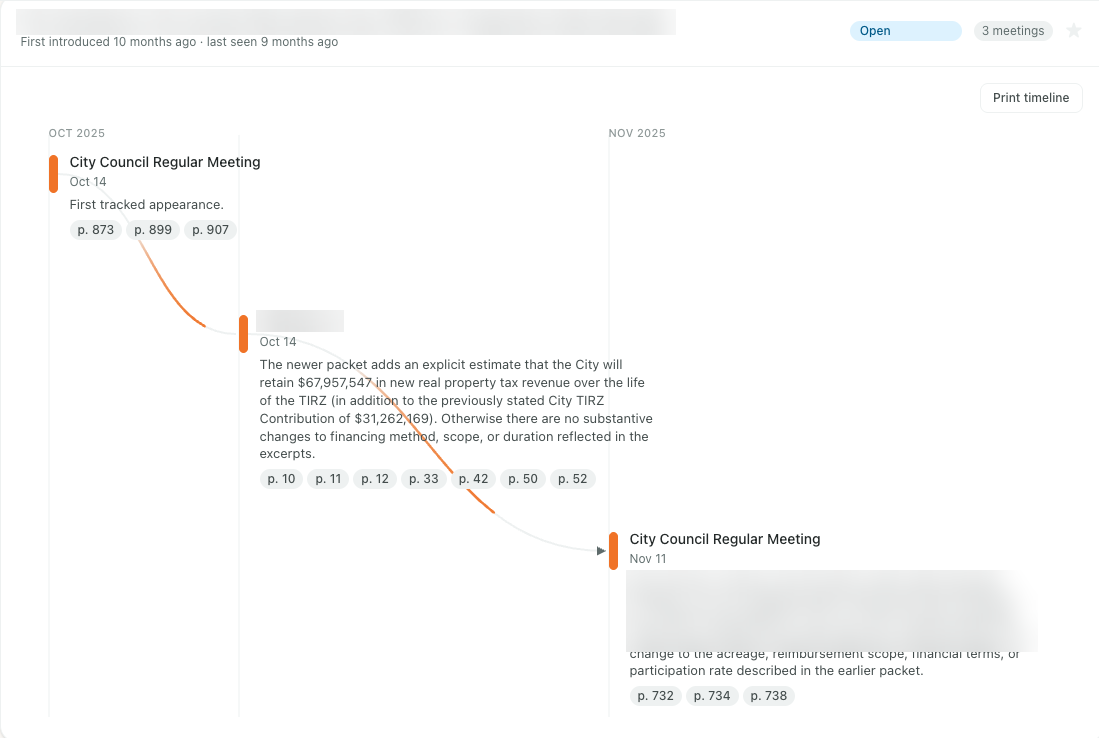
Every appearance, in order
One subject, tracked across meetings: when it was first introduced, every packet it has appeared in since, and what changed each time — a new revenue estimate here, an added party and an adopted ordinance there. Each entry carries the pages it was read from, so any claim on the timeline is one click from the source.
This is also what makes cross-year conflict detection possible: the timeline is the history a new figure gets compared against.
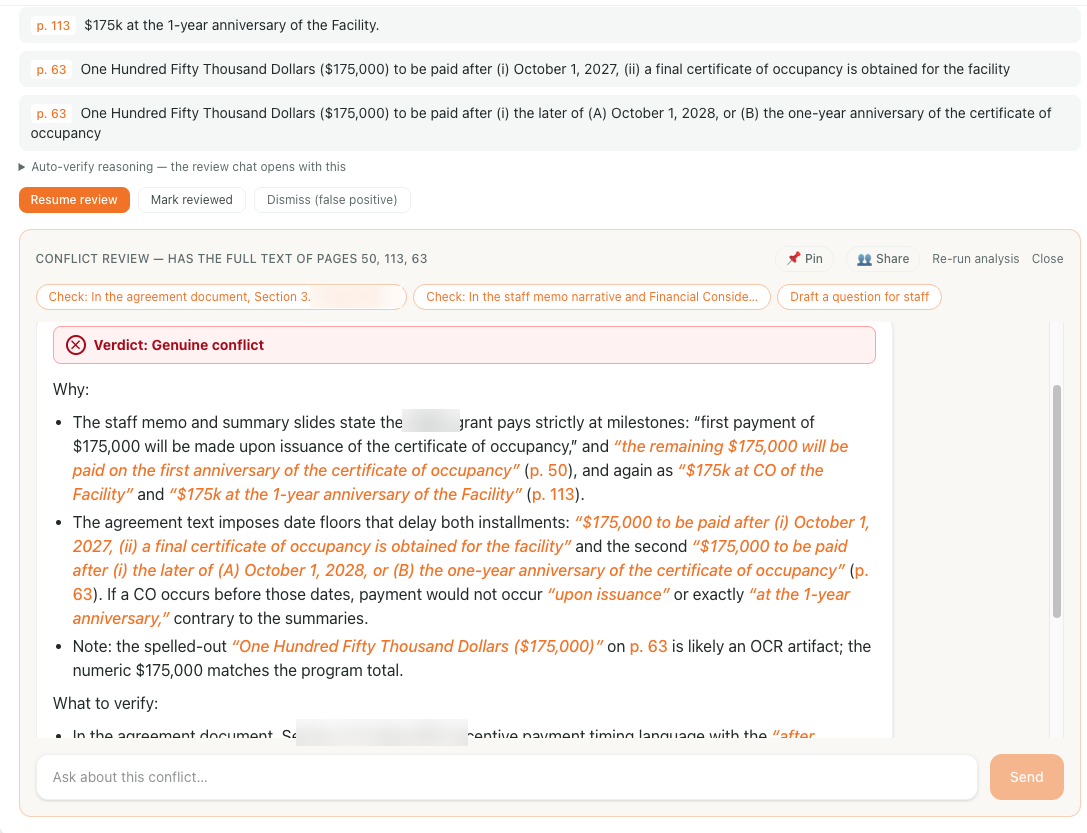
Then talk it through
A finding opens with the conflicting language quoted side by side, each line tied to its page, and the verdict with the reasoning that produced it — including when a mismatch turns out to be an OCR artifact rather than a real disagreement.
From there it is a conversation. The review chat holds the full text of the cited pages, so you can press on it: check a specific section, ask what the agreement actually obligates, or have it draft the question to send staff. Mark it reviewed, dismiss it as a false positive, re-run the analysis, or share it — and every answer stays inside the pages it can cite.
Point it at your agenda portal
Adapters ship today for CivicClerk, Municode Meetings, OnBase and Legistar. Nothing to migrate, nothing to replace — new packets are picked up automatically when your city publishes them.
Every page gets read
Items are split out, summarized, cross-checked against earlier meetings, and indexed down to the page — including scanned exhibits and the numbers inside them.
Your council and staff go in prepared
Usually within two weeks of signing. Unlimited users — every council member, the clerk, and staff, all included.
Designed to work alongside your existing agenda portal — keep the system you have; nothing to migrate, and no change to how your clerk publishes.
The questions your city attorney and your records officer will ask, answered before they ask them.
Nothing here trains an AI model
Your packets and your people's questions are never used to train anyone's models. Everything is encrypted in transit and at rest on Google Cloud.
Built around the Open Meetings Act
No member can read another member's notes or questions — the product cannot become a channel for deliberation outside a posted meeting. Sharing an item with more than one member of the governing body is refused by the server, not by a warning label.
Ready for an open-records request
Member notes and questions remain city records. Your administrator can export any member's complete file on demand — as a printable document or plain text — in minutes rather than days.
Priced to be easy to buy.
Your price is set by how many people work for your city — not by seats. Under most cities' approval thresholds, so it closes in weeks rather than quarters.
| No. | Property | Value | Remark |
|---|---|---|---|
| 01 | Ceiling, every tier | <$0/yr | Under the Texas competitive-bidding threshold |
| 02 | Per-seat fees | $0 | Council, clerk and staff — all included, always |
| 03 | Annual invoices | 0 | Against a PO, net-30, on Texas Prompt Payment terms |
| 04 | Increase cap | 0%/yr | Or lock your price for three years |
Renewals co-termed to October 1, quoted 60–90 days ahead so it lands in the budget build.
See it on your own packet.
The most useful thirty minutes is a walkthrough on a packet your city actually published — your items, your numbers, your history. Built and proven on real published North Texas city packets.